
What Wall Street’s 10-Year Stock Market Forecasts Mean for Income Investors
If you’re an income-focused investor planning for retirement or building wealth, the next decade may look very different from the last. Major Wall Street institutions—including Goldman Sachs, Vanguard, J.P. Morgan, and BlackRock—are projecting significantly lower stock market returns over the next ten years compared to historical averages. These stock market forecasts represent a fundamental shift in the investment landscape.
For investors who depend on portfolio income or seek stable, predictable returns, this shift demands a serious reassessment of traditional investment strategies. In this article, we’ll break down what the experts are forecasting, why it matters, and how alternative investments like mortgage notes can help you achieve your income goals even in a lower-return environment.
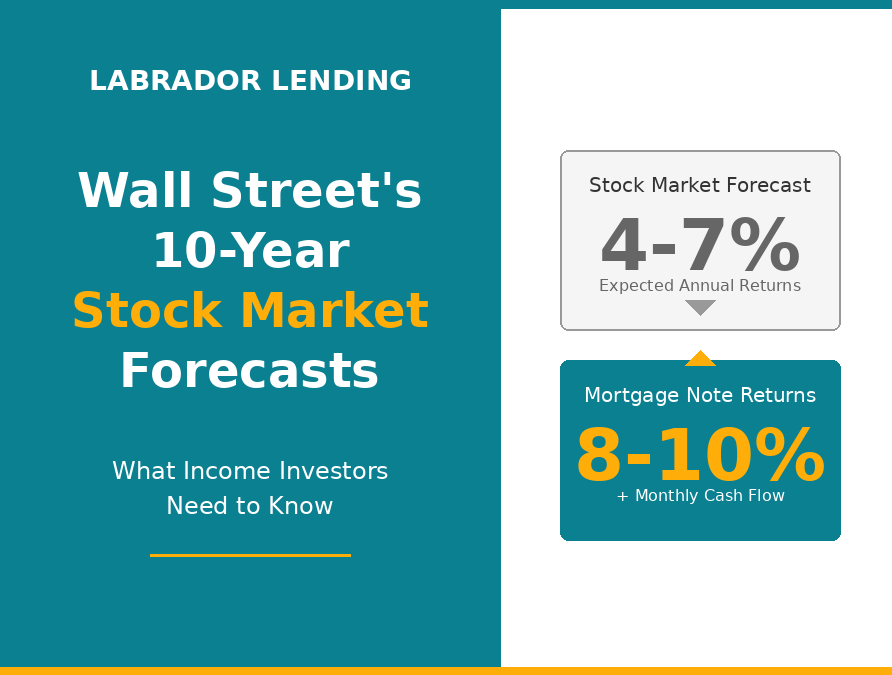
Key Takeaway: Wall Street’s consensus forecast for the next decade is 4–7% annual stock returns—well below the historical average of approximately 10%. For income investors, this creates both a challenge and an opportunity to explore alternatives that can deliver higher, more consistent cash flow.
The Expert Consensus: Lower Stock Market Returns Ahead
When some of the world’s most sophisticated investment firms all arrive at similar conclusions, it’s worth paying attention. Here’s what the major institutions are forecasting for stock market returns over the next decade (sources include Vanguard’s Economic Outlook and BlackRock’s Capital Market Assumptions):
| Institution | 10-Year Expected Annual Return | Key Notes |
|---|---|---|
| Goldman Sachs | ≈ 6.5% | Baseline scenario; range of 3–10% depending on valuations |
| Vanguard | 4–5% | Valuation-sensitive model; historically conservative |
| Morningstar / Research Affiliates | 3–6% | Based on valuation reversion and modest earnings growth |
| Northern Trust | ~7.1% | Global equities; U.S. slightly lower |
| BlackRock | 5.5–7% | Capital Markets Assumptions; moderately optimistic |
| Fidelity | 4–6% | Forward P/E ratios at elevated levels |
| J.P. Morgan | 5–6% | Long-term capital markets assumptions |
| Consensus Range | 4–7% | Broad agreement on lower-than-historical returns |
Sachs
Trust
Morgan
Key Insight: All major institutions project returns significantly below the historical 10% average
Why Are Experts Predicting Lower Returns?
Several key factors are driving these more conservative forecasts:
1. Elevated Valuations
Stock valuations are currently high by historical standards. When price-to-earnings ratios are elevated, future returns tend to be lower as valuations normalize over time. Markets that start expensive rarely deliver above-average returns.
2. Modest Earnings Growth Expectations
Corporate earnings growth is expected to moderate compared to the exceptional growth seen in recent years. Without strong earnings expansion, stock prices have less room to rise dramatically.
3. Rising Interest Rates Environment
Higher interest rates make bonds more attractive relative to stocks and increase the discount rate used to value future earnings. This creates headwinds for equity valuations and can compress stock market multiples.
4. Economic Uncertainty
Geopolitical tensions, inflation concerns, and potential recession risks all contribute to a more uncertain economic outlook, which typically results in more volatile and lower average returns.
What This Means for Income Investors
If you’re investing for income—whether for retirement, passive cash flow, or wealth preservation—these lower return expectations create significant challenges:
- Reduced Portfolio Growth: A 4–7% return may not keep pace with your income needs or inflation over time
- Limited Dividend Income: Lower stock returns often correlate with modest or stagnant dividend growth
- Increased Volatility Risk: Unpredictable market swings make it harder to plan withdrawals or rely on consistent income
- Sequence of Returns Risk: For retirees drawing down portfolios, poor early returns can permanently damage long-term wealth
Traditional 60/40 portfolios (60% stocks, 40% bonds) may no longer provide the income and stability that investors have historically relied upon. Bonds, while safer, are also offering relatively modest yields in the current environment.
The Case for Mortgage Note Investing
This is where alternative investments like first-lien mortgage notes become compelling. Mortgage notes offer a unique combination of attributes that can help income investors navigate a lower-return stock market environment:
- High volatility expected
- Unpredictable returns
- Limited cash flow
- No collateral backing
- Monthly cash flow
- Contractual payments
- Real estate collateral
- Low stock correlation
Key Benefits of Mortgage Note Investing
How Mortgage Notes Compare in Practice
Let’s look at a practical comparison. Assume you’re investing $100,000 and evaluating your options:
| Investment Type | Expected Annual Return | 10-Year Value | Total Income Generated |
|---|---|---|---|
| Stock Portfolio (5% avg) | 5% | $162,889 | ~$62,889 |
| Bond Portfolio (4% avg) | 4% | $148,024 | ~$48,024 |
| Mortgage Notes (8.5% avg) | 8.5% | $227,519 | ~$127,519 |
Over a decade, the difference in total returns is substantial. But equally important for income investors is the consistency and predictability of those returns. Mortgage notes provide contractual monthly payments, while stock dividends can be cut and portfolio values can swing wildly year to year.
Who Should Consider Mortgage Note Investing?
Mortgage note investing is particularly well-suited for:
- Retirees and Pre-Retirees: Those who need reliable monthly income and can’t afford significant portfolio volatility
- Conservative Investors: People who want equity-like returns without equity-like risk
- Diversification Seekers: Investors looking to reduce correlation with stock and bond markets
- Income-Focused Investors: Anyone prioritizing cash flow over capital appreciation
- Real Estate Enthusiasts: Those who like real estate but don’t want the responsibilities of being a landlord
Whether you’re a passive investor seeking hands-off income or exploring alternative investment strategies, Labrador Lending offers solutions tailored to different investor types.
The Labrador Lending Approach
At Labrador Lending, we specialize in first-lien mortgage note investments through our Integrity Income Fund (IIF). Our fund provides individual investors access to professionally managed mortgage note portfolios without requiring them to source, underwrite, or service notes themselves.
Integrity Income Fund Highlights:
- For Accredited Investors: Fund is available to accredited investors only
- Target Returns: 8–10% annual preferred returns
- Monthly Distributions: Consistent cash flow deposited to your account
- Professional Management: Experienced team handles all due diligence, servicing, and asset management
- Diversification: Fund invests across multiple notes and geographies to spread risk
- Real Estate Backing: Every note is secured by physical property
- Commitment Period: Short one-year minimum investment period
Our approach focuses on first-lien positions, meaning we hold the senior debt position on the property. This provides the strongest level of protection and priority in the event of borrower default. Download our complete Fund Overview PDF to learn more about our investment strategy and due diligence process.
Ready to Explore Mortgage Note Investing?
Most major investment firms—including Goldman Sachs, Vanguard, and J.P. Morgan—forecast only 4–7% average annual stock-market returns over the next decade. With valuations stretched and volatility rising, many investors are turning to alternatives with stronger income profiles and real collateral.
Learn how the Integrity Income Fund can help accredited investors achieve their income goals with 8–10% annual preferred returns, monthly cash flow, and real estate-backed security.
Learn More About Fund Start Your InvestmentFive Key Takeaways
- Wall Street consensus: Expect 4–7% stock returns over the next decade—well below historical norms
- Income challenge: Traditional portfolios may not generate sufficient cash flow for retirement or income needs
- Alternative solution: Mortgage notes offer 8–10%+ returns with monthly distributions and real estate collateral
- Risk mitigation: First-lien positions provide senior debt protection backed by tangible assets
- Professional access: Funds like Labrador Lending’s IIF make institutional-quality mortgage note investing accessible to individual investors
Conclusion
The investment landscape is shifting. With major Wall Street firms projecting significantly lower stock market returns for the decade ahead, income investors need to think differently about portfolio construction and return expectations.
Mortgage note investing represents a compelling alternative for those seeking higher, more predictable income streams backed by real assets. While no investment is without risk, first-lien mortgage notes offer a unique risk-return profile that can complement traditional portfolios—or serve as a core holding for income-focused investors.
As you plan for the next decade, consider whether your current investment strategy is positioned to meet your income needs in a lower-return environment. The experts have spoken clearly about their expectations. The question now is: how will you adapt?
Disclaimer: This article is for informational purposes only and does not constitute investment advice. All investments carry risk, including the potential loss of principal. Past performance does not guarantee future results. Forecasts and projections are based on current market conditions and expert opinions, which can change. Before investing, please consult with a qualified financial advisor and review all fund documents carefully.